A Digital Twin Sized for Small Businesses — Ask a Simulator First When a Real Test Is Expensive (1)
Decisions like changing a line, bringing in equipment or remaking a prototype cost a lot just to try once. Questions like these can be run through a small simulator first, and now that AI can write the analysis code, the barrier is even lower. Part 1 draws on Kia's Gwangmyeong plant, a Korean government smart factory program, the KISTI Virtual Design Center and small-business cases to set out which questions to give a simulator and which to avoid.
Decisions you can't test are usually made on gut feel. You can slip a small simulator in between.
Questions that cost tens of millions of won to try once
Some decisions small-business executives make don't allow "let's just try it and fix it later."
- If we switch to thinner packaging boxes, how much will damage in transit increase?
- If we rearrange the warehouse shelves like this, will the picking routes get shorter?
- If we bring in one more machine, will the bottleneck clear, or just move to another process?
- If we modify the mold like this, how many more times will we have to machine the prototype?
Testing questions like these even once takes a lot of money and time. So they are usually decided by relying on the gut feel of experienced staff or on what suppliers say. If the decision is wrong, it gets fixed later at great cost.
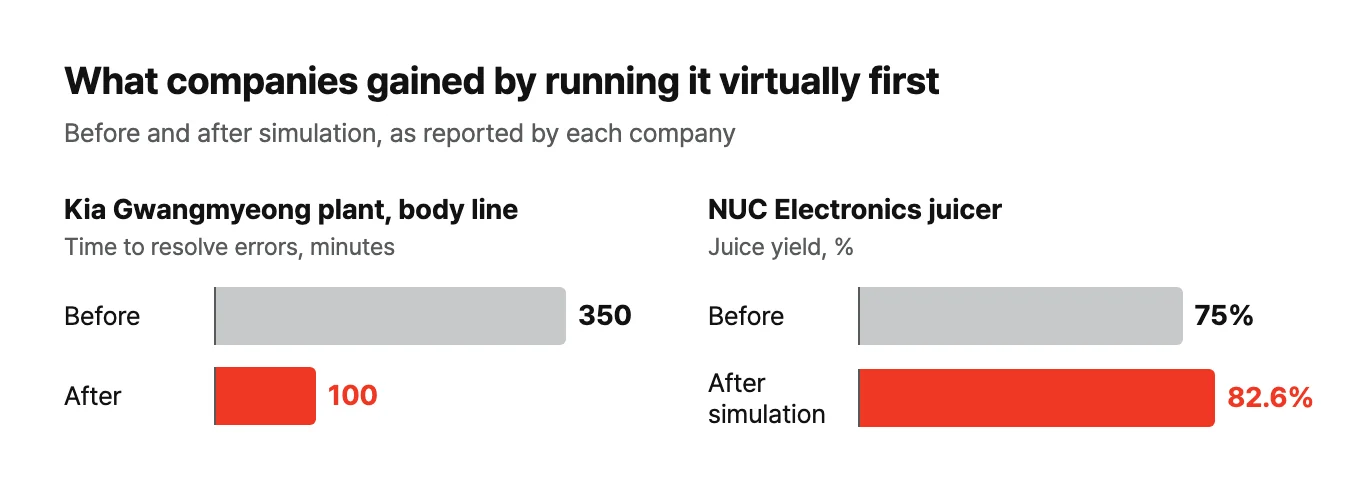
Large companies are filling this gap with digital twins. Kia said it attached a digital twin to the body line at its Gwangmyeong plant, cutting the time needed to resolve errors from 350 minutes to 100 minutes and saving 3,750 hours a year (Seoul Economic Daily, in Korean). The Korean government also wants to extend this trend to small and mid-sized firms. The Ministry of SMEs and Startups' 2024 autonomous factory program selected 20 companies and gave each up to 600 million won over as many as two years to add digital twin-based advance prediction and quality simulation (Herald Business, in Korean).
News like this makes it easy to think, "That's a story for companies that can afford to replicate an entire factory." But the core of a digital twin is not copying the whole factory exactly. It is running things virtually before doing them for real. That can be done at a much smaller scale.
Simulation has long been a small-business tool as well
Simulation has been a way to support small businesses for longer than you might think.
In 2011, the Korea Institute of Science and Technology Information (KISTI), a government research institute, ran a 5 billion won program with the Small and Medium Business Administration to give small businesses access to modeling and simulation environments. One small business in the program used supercomputer simulation while developing a personal disaster lifesaving device and cut a technology development period that had taken more than a year down to 6 months (Digital Times, in Korean). Small appliance maker NUC Electronics used the same KISTI supercomputer to simulate the angle and conditions of a juicer's screw, raising juice yield from 75% to 82.6% (Edaily, in Korean). From 2004 to 2018, the KISTI Virtual Design Center supported technology and product development at 539 companies in this way (Korea Industrial Daily, in Korean).
What these cases have in common is one thing: they failed many times on screen before machining a prototype. Back then, though, it took a supercomputer and analysis specialists. Today the barrier is one step lower, because AI writes the simulator code. You can have AI find published formulas and coefficients, assemble them and even draw the graphs.
With the barrier lower, there is something to decide first: what to ask.
Principle 1. Give it comparative questions
The questions a simulator answers most reliably are not "exactly how much is this?" but "under the same conditions, what breaks down first, and how much better does it get if we change something?"
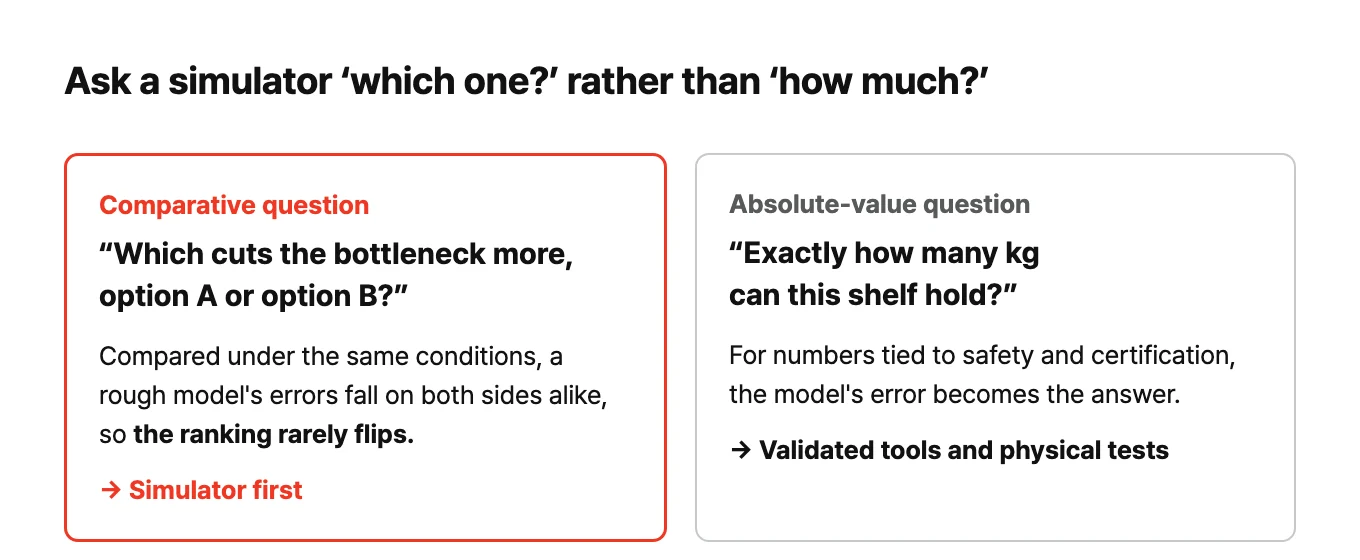
The juicer case is a good example. The question the simulation answered was closer to "if we change the screw angle like this, will it do better than now?" than to "what is the exact juice yield in percent?" When you put several options under the same conditions and compare them, even a somewhat rough model introduces similar errors on both sides, so the ranking rarely flips.
Most company decisions are comparative too. Which option, A or B, cuts the bottleneck more? Does reducing thickness push damage up? By contrast, absolute values such as "exactly how many kilograms can this shelf hold?", especially numbers tied to safety and certification, should be confirmed with validated tools and physical tests.
Before handing a question to a simulator, try writing it as a single sentence: "Comparing what with what, to decide what?" If you can't write that sentence, the simulator won't be used for the decision even if you build it.
Some questions don't suit a simulator
Not every decision needs a simulator. Three kinds of questions are better avoided.
Questions that are cheaper to just try. If testing is cheap and easy to undo, like changing a shelf display for a day, building a simulator costs more time than it saves. Just try it and keep a record.
Questions with no yardstick at all. With no field measurements, no published data and no past records, there is nothing to check the simulator's output against. The numbers that come out are closer to your assumptions read back to you. It is better to take one small field measurement first.
Questions where human reactions are the core. Whether customers will leave after a price increase, or whether employees will accept a new policy, cannot be solved with laws of physics. Using a simulator on questions like these produces numbers that look precise but actually cloud judgment.
On the other hand, questions governed by clear laws with published material values, such as force, heat, flow, volume and routes, are where simulators fit best. The more a field has its formulas and coefficients published in tables, the faster AI can find the ingredients and assemble them.
Here are the four cases in a table.
| Type of question | Example | Simulator |
|---|---|---|
| Cheaper to just try | Changing a shelf display for a day | Not a fit. Try it and record |
| No yardstick at all | No field measurements, published data or past records | Not a fit. Start with a small measurement |
| Human reactions are the core | Customer churn after a price increase, acceptance of a new policy | Not a fit |
| Clear laws, published material values | Force, heat, flow, volume, routes | Best fit |
Checklist for choosing a question
Before building a simulator, answer these five questions.
- How much would it cost, and how long would it take, to actually test this decision once?
- Can you write the question as a comparative sentence: "Which of A and B reduces X more?"
- Do you have at least one field measurement or published figure to check the results against?
- Is the phenomenon explained by laws of physics or volume calculations, or does it depend on people's choices?
- Have you decided in advance which decision you will change once the results are in?
If you can answer "yes" to four or more, the question is worth trying. At this scale you can start without a separate budget, and when the stakes grow, as with prototypes or equipment investments, look into government support as well. How to use it is covered in The Government Will Help Pay for AI, and how to start with a small budget in Starting AI on a Budget.
In summary
Ask a simulator first when a real test is expensive. You don't need to replicate the whole factory. One comparative question and one phenomenon governed by clear laws are enough to start. Avoid questions that are cheaper to just try, that have no yardstick to check against, or where human reactions are the core.
That said, a simulator written by AI usually runs, and the graphs usually look plausible. The next part covers what to check before using those results in a decision.
Series: A Digital Twin Sized for Small Businesses
- Ask a simulator first when a real test is expensive (this article)
- What to check before trusting a simulator AI built
References
- 서울경제, 4명 손쓸 일 1명이서 해결… 제조혁신 이끄는 이 기술 (2026) (in Korean; Seoul Economic Daily, "One person handles what took four: the technology driving manufacturing innovation")
- 헤럴드경제, 심텍·HL만도·코아비스 등 AI·디지털트윈 도입한다 (2024) (in Korean; Herald Business, "Simmtech, HL Mando, Coavis and others to adopt AI and digital twins")
- 디지털타임스, 중소기업 모델링&시뮬레이션 환경지원사업 (2011) (in Korean; Digital Times, "Modeling and simulation environment support program for SMEs")
- 이데일리, 中企 기술개발에 슈퍼컴도 이용 (2014) (in Korean; Edaily, "SMEs use supercomputers for technology development")
- 산업일보, KISTI 가상설계센터 539개 기업 지원 (2018) (in Korean; Korea Industrial Daily, "KISTI Virtual Design Center has supported 539 companies")