Break Your AI Adoption Roadmap into Small Pieces: Why Big Projects Fail More Often
Companies that launch AI transformation as a single one-year mega-project are the ones that stall most often. Drawing on data showing a 61% success rate for small projects versus 6% for very large ones, this guide explains how to split an AI adoption roadmap into three layers (direction, quarterly goals and 2–4 week tasks), how to choose which tasks to start with, and the traps to avoid when you break the work down.
Most AI adoption plans start big. And most of them stall because of that size.
"Company-wide AI transformation within a year"
This line shows up again and again in AI adoption plans written for leadership. "Transform every function with AI." "Fully automate customer service." "Build an integrated AI platform." The goals are big, the timeline is a year, and so is the budget.
Plans like these look great in a board presentation. In execution, though, they tend to follow the same path. Three months to gather requirements, two months to select a vendor. By the time the first deliverable appears, the business teams have lost interest, and AI technology has moved on a full generation. We covered this pattern in detail in Why AI projects fail.
The roadmaps at companies where AI works look different. The direction is big, and the tasks are small.
Big projects really do fail more often
The numbers are clear.
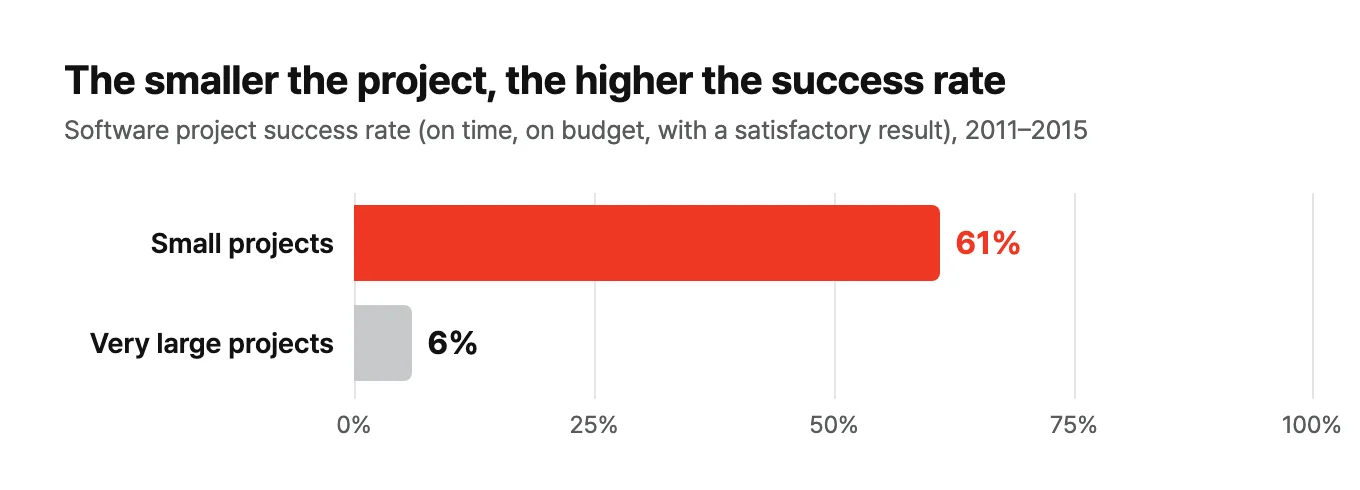
According to the Standish Group's 2015 CHAOS Report, small software projects had a 61% success rate, while very large projects had just 6%. That is a tenfold difference.
The 2019 report from Google's DORA research team points the same way. Elite organizations that ship small changes often deployed 208 times more frequently than low performers, recovered from incidents 2,604 times faster, and had one-seventh the change failure rate.
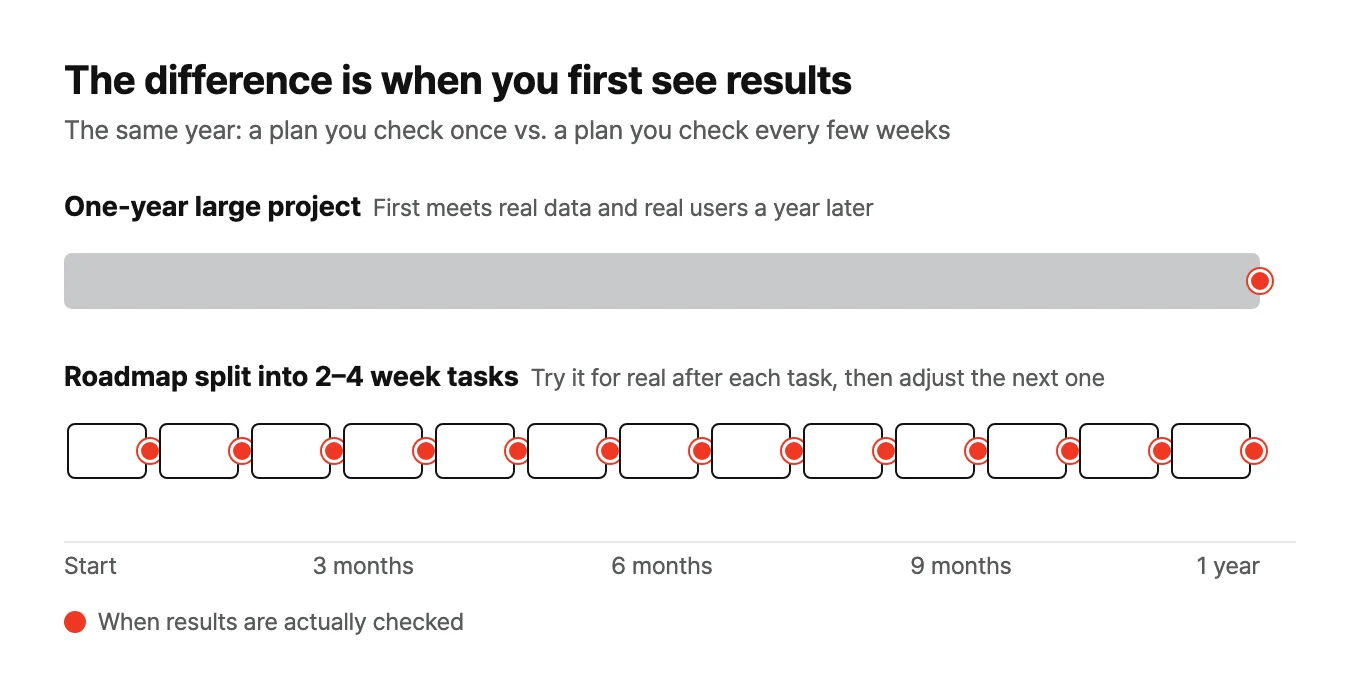
With AI projects, the gap grows wider. Conventional software usually works if you build it to spec, but with AI you cannot know the outcome until you put it in front of real data and real users. Checking for the first time after a year means taking on a year's worth of risk in one go.
Split your roadmap into three layers
The structure we recommend has three layers.
| Layer | Time frame | Example |
|---|---|---|
| Direction | 1–2 years | "Cut the time our sales team spends on customer handling in half" |
| Quarterly goal | 3 months | "AI automatically prepares meeting prep materials" |
| Task | 2–4 weeks | "Send Sales Team 1 a one-page summary of each client's latest news every day" |
The direction should be specific enough to write down as a single number. "AI transformation" is not a direction; it is a slogan.
A task should be small enough that you can see when it is finished. It should produce something that actually runs within 2–4 weeks, and anyone should be able to tell whether it is done.
| Task that is too big | A first task, broken down |
|---|---|
| Automate customer service | Draft answers to the 20 most frequently asked questions |
| Make internal knowledge searchable with AI | Have it answer questions about one HR policy document |
| Automate report writing | Have it write only the narrative section of one weekly sales report |
Then order the tasks so that each one becomes material for the next. The experience of answering 20 questions becomes the foundation for the next 50, and the structure you built for one HR policy extends as is to other policy documents.
Four criteria for choosing tasks
If you have several candidate tasks under a quarterly goal, score them on these four questions.
1. Does it move the direction? When this task is done, will the direction's number move even a little? If not, push it back, however easy it is.
2. Can you measure the effect? Is there a baseline to compare before and after, such as processing time, volume or error rate? We have laid out how to measure this in How to measure results after adopting AI.
3. Can you undo it if it goes wrong? Early tasks should be set up so that a person checks the output. Leave tasks whose output goes straight to customers for later.
4. Does it extend to the next task? Can the structure of this task be reused by another team or for another document? Tasks that extend are the ones that pay interest.
Small wins move organizations
Breaking work down does not pay off only in schedules and risk. It pays off in people, too.
Teresa Amabile's research team at Harvard Business School analyzed roughly 12,000 diary entries from 238 employees at seven companies. What lifted employees' daily motivation the most was not grand rewards but small progress in meaningful work.
Applied to AI adoption, it works like this. An "integrated AI platform" due a year from now is someone else's project as far as the business teams are concerned. An employee who sees meeting notes being summarized automatically this week starts looking for the next thing to automate on their own. As we discussed in Building people who use AI, what drives adoption is often hands-on experience more than training.
The same goes for persuading leadership. Psychologist Karl Weick, who articulated the idea of "small wins," argued that as visible results pile up, others join the momentum and even opponents come around. The most persuasive material is not a plan but a result that is already running. We go further into this in How to convince leadership to adopt AI.
Two traps when breaking things down
Trap 1: You end up choosing only the easy tasks. Once work is split into small pieces, it is tempting to start with whatever is easiest to tackle. Tasks like document summaries or polishing copy finish quickly and are easy to report as wins. Meanwhile, the hard questions, such as "Will the team actually use this every day?" or "Will this lower our costs?", keep getting pushed back. Ask yourself every quarter: are we breaking down what matters, or only what is convenient to break down?
Trap 2: The steps become a formality. The surgical checklist proposed by surgeon Atul Gawande cut post-surgical mortality from 1.5% to 0.8% at hospitals in eight countries. Yet when 101 hospitals in Ontario, Canada, were analyzed after the checklist became mandatory, mortality did not fall meaningfully. The difference is generally read as whether teams actually stop and check, or just fill in the boxes. AI roadmaps work the same way. The moment marking a task "complete" becomes the goal, the work itself stays the same. The bar for "complete" should not be whether a deliverable exists, but whether the business team is actually using it.
Questions for the quarterly review
At the end of each quarter, check just these three things.
- Did this quarter's tasks move the direction's number?
- Of the tasks you finished, how many is the business team still using today?
- What hard questions have you put off, and how will you break them down next quarter?
If there is no answer to the third question, that is a sign your roadmap is drifting toward the easy side.
Wrapping up
Open your AI adoption plan again. If the first task takes several months, it is too big. Cut it down to one block you can see the end of within this month, and write one line on which direction that block points to.
Big results do not come from setting them as a target. They follow organizations that stack small wins in line with a direction. If you are not sure where to start, we suggest filling out one page of the AI readiness checklist first.
A hands-on experiment with this topic is written up in How to Repeat Small Wins (1): Breaking Things Down Is the Oldest Trick in the Book.
References
- The Standish Group, CHAOS Report 2015
- DORA, Accelerate State of DevOps 2019
- Harvard Business Review, The Power of Small Wins (2011)
- Weick, Small Wins: Redefining the Scale of Social Problems, American Psychologist (1984)
- Haynes et al., A Surgical Safety Checklist to Reduce Morbidity and Mortality in a Global Population, NEJM (2009)
- Urbach et al., Introduction of Surgical Safety Checklists in Ontario, Canada, NEJM (2014)