Handing a Veteran's Intuition to AI — Breaking Intuition into Measurable Conditions (1)
An expert's intuition leaves the company on the day that person retires. What you can hand to AI is not the intuition itself but a set of criteria: the intuition broken into conditions, each with a way to measure it. Part 1 draws on Matsushita's bread maker, the Apgar score, a Korean government pilot program on tacit manufacturing knowledge and a press-line project to show how to split a veteran's judgment into named conditions and attach a measurement method to each.
The intuition only one person has leaves the company on the day that person retires. What you can hand to AI is not the intuition itself but the criteria you get by breaking it down.
"Ask the line supervisor about that"
Every factory has someone like this. The person who hears the press and says "something's off with the die today" and stops the line. The person who presses the dough and says "10 more minutes." The person who skims a quote and says "this supplier won't make the deadline." They are usually right. But ask why, and the answer is "you can just tell."
This intuition is a major company asset. It is also an asset the company cannot control. When that person goes on vacation, the judgment stops. When they retire, it disappears.
The Korean government has started to treat this as a policy problem. The Ministry of Trade, Industry and Resources launched a pilot program to develop AI models based on tacit manufacturing knowledge (in Korean), using 48 billion won from the 2026 supplementary budget to turn skilled workers' know-how in 30 selected processes into data and build AI models from it. Each project receives about 1.6 billion won for one year (HeraldK, in Korean). The background is simple: as an aging workforce sends master craftspeople into retirement, their know-how is at risk of being lost.
So the question is this: how do you turn "you can just tell" into something AI can use? Part 1 covers the first step: breaking intuition into conditions and attaching a way to measure each.
Imaging the output does not reveal the intuition
First, a common misconception. Many expect that if you install enough sensors and pile up enough data, intuition will be learned on its own.
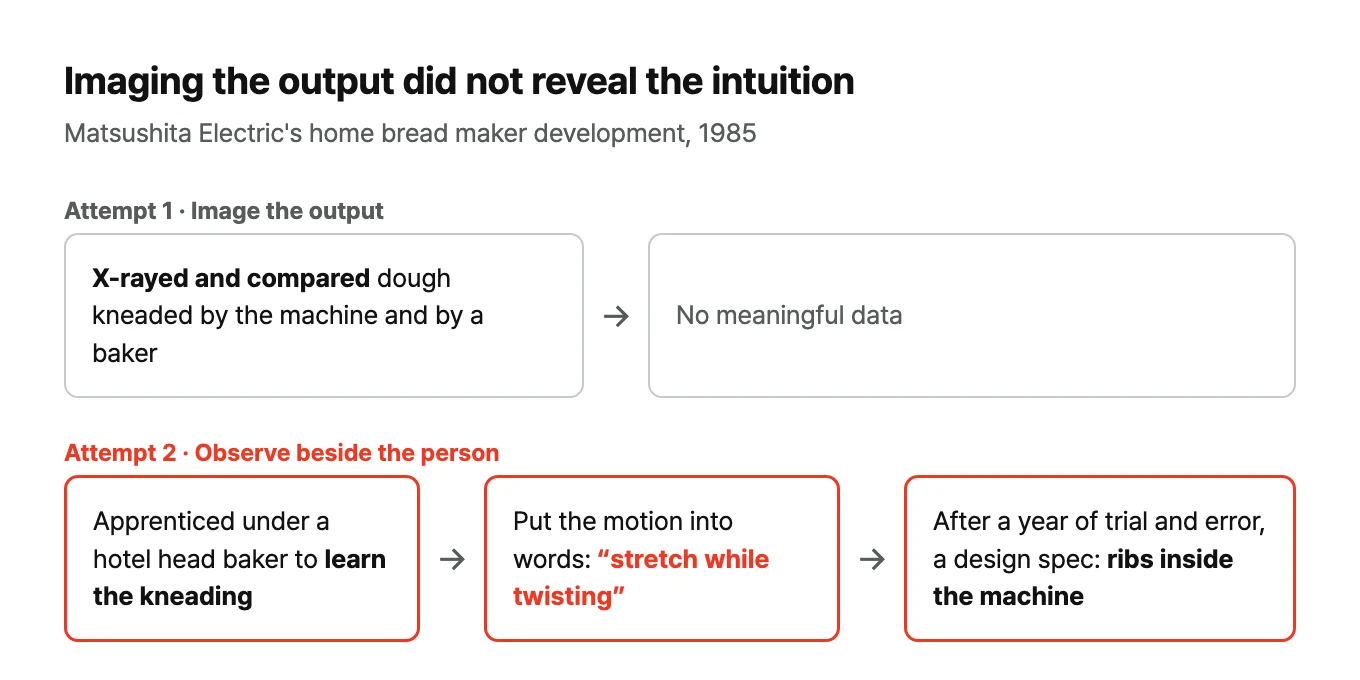
Ikujiro Nonaka, who popularized the term tacit knowledge in management, gives a case that shows this misconception well in his Harvard Business Review article "The Knowledge-Creating Company". In 1985, developers at Matsushita Electric were building a home bread maker, but the bread came out burnt on the outside and underdone inside. The team even X-rayed and compared dough kneaded by the machine and dough kneaded by professional bakers, but obtained no meaningful data.
The breakthrough came from software developer Ikuko Tanaka. She apprenticed herself to the head baker of the hotel reputed to make the best bread in Osaka. She noticed that the baker stretched the dough in a distinctive way, and after a year of trial and error with the engineers, the team reproduced the motion with a specification that added special ribs inside the machine. The product set a first-year sales record for a new kitchen appliance.
The key point here is the order. No matter how precisely the output (the dough) was imaged, the intuition did not show up. It became a design specification only after someone watched what the person did, right beside them, and put it into words: "stretch while twisting." Nonaka called this the movement of tacit knowledge into explicit knowledge.
The order is the same in the AI era. Before data collection, there has to be a step where intuition is broken into words.
Principle 1. Break intuition into a few named conditions
In 1952, American anesthesiologist Virginia Apgar broke the "feel" doctors used to judge a newborn's condition into five items: heart rate, breathing, muscle tone, response to stimulus and skin color. Each item gets 0 to 2 points, and the points are added up. This proposal, published in a journal in 1953, is still used in delivery rooms today under the name Apgar score.
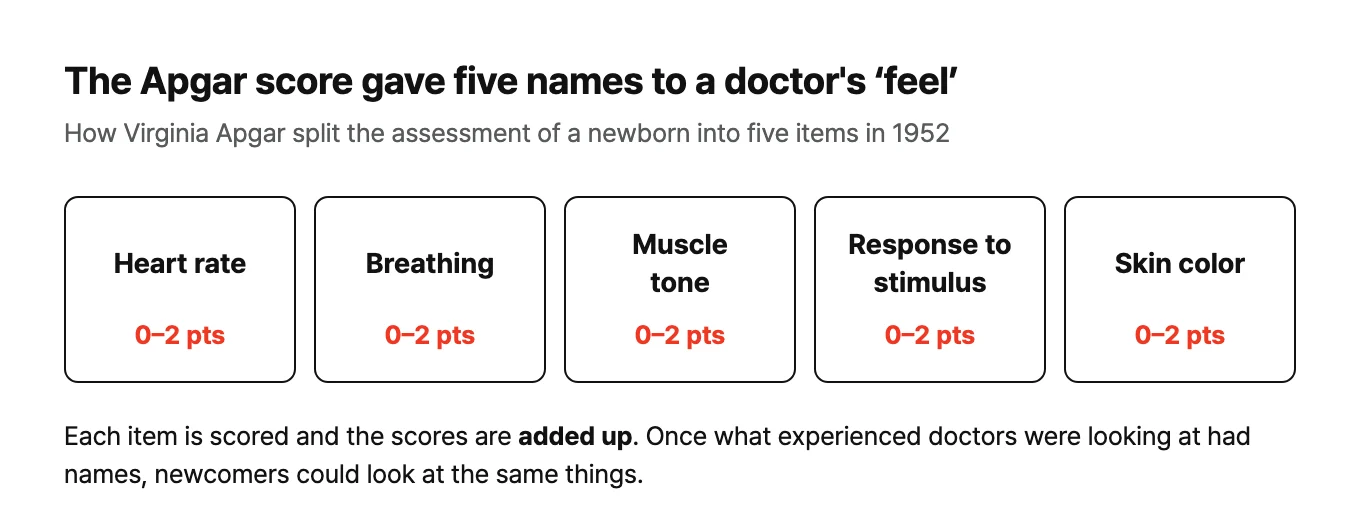
The Apgar score has lasted not because it is sophisticated. It lasted because it gave names to what experienced doctors were looking at. Once there are names, newcomers look at the same places, and different judgments can be compared.
The same thing is happening on Korean shop floors. A project to turn a press-line master's tacit knowledge into data (in Korean), one of the government program's projects, targets a press mass-production line in the Pyeongdong Industrial Complex in Gwangju. It breaks down what the master looks at to pinpoint the cause of a dent defect into conditions (die wear, whether the material is seated properly and subtle vibration sounds from the equipment) and ties work videos, audio, sensor data, inspection images and drawings to those conditions. A vague record of "there was a defect and the master fixed it" turns into the question "which of the three conditions went wrong?"
Practical tip: 5 to 8 conditions is about right. With 3 or fewer, the texture of the intuition is lost; beyond 15, even the expert cannot weigh the conditions against each other. Use the words the expert already uses as the names, and you will meet less resistance.
Principle 2. Write down how each condition will be measured
Naming the conditions is only half the job. Phrases like "just the right undulation," "the sound is clean" or "the dough is alive" work for people but mean nothing to a machine.
Once you attach a measurement method to each condition, conditions missing from the data come to light right away. If the master judges by "sound," that sound is not in today's equipment logs. If they judge by "feel in the hand," there is no device measuring touch. This is also why the press project collects audio separately, on top of video and sensor data. Put this into a table ahead of time.
| Condition | How the expert puts it | Measurement method | Do we have the data now? |
|---|---|---|---|
| Die condition | "The edge has gone a bit dull" | Stroke count, wear measurements | Partly |
| Equipment sound | "The sound is muddy" | Vibration and acoustic sensors | No |
| Material seating | "It's lifted slightly" | Vision camera | No |
The last column of this table is your investment list. When you check whether your company's data is ready for AI, you can start from this table as well.
When you write down measurement methods, record two more things. One is the unit and frequency of measurement. Whether you check die wear every stroke or every shift changes the equipment you need. The other is when the expert looks at that condition. If the master listens to the sound right after the press comes down, the sensor has to capture that moment too.
Common traps at the breakdown stage
Stopping at transcribing the manual. Ask an expert to "write down your know-how," and you usually get a document much like the existing work standard. The experts themselves are not aware of what they are judging by. Just as the Matsushita team found no answer in X-ray images, collecting documents alone will not surface intuition. Catch the moment a judgment is made on the floor and ask right there: "Why did you stop just now?" "What did you see?"
Turning one expert's intuition into the company standard. Show the same case to two masters, and their judgments diverge more often than you would expect. The points where they diverge are exactly where the criteria are not yet broken down enough. Whenever possible, put the judgments of two or more people side by side and first check where they split.
In summary
A veteran's intuition is not mysterious. It is a bundle of conditions that have not been named yet. Rather than imaging the output, observe beside the person, break the intuition into 5 to 8 named conditions and write down how each will be measured. The blanks in that table become your first investment list.
The next part covers how to combine the conditions you have broken out, how far intuition can be trusted, and what role the experts should take.
Series: Handing a Veteran's Intuition to AI
- Breaking intuition into measurable conditions (this article)
- Exposing the weights and making experts the reviewers
References
- 산업통상부, 제조 명장과 청년이 함께 제조 노하우를 지켜나간다 (2026) (in Korean; Ministry of Trade, Industry and Resources, "Manufacturing masters and young workers preserve manufacturing know-how together")
- 헤럴드K, 산업부 제조 암묵지 기반 AI모델 개발 본격 추진…올해 480억원 투입 (2026) (in Korean; HeraldK, "Ministry moves ahead with AI models based on tacit manufacturing knowledge, 48 billion won this year")
- 세계일보, 숙련공의 손길 AI로 데이터화… 명장의 감 다 살렸어 (2026) (in Korean; Segye Ilbo, "A skilled worker's touch turned into data with AI, capturing the master's feel")
- Ikujiro Nonaka, The Knowledge-Creating Company, Harvard Business Review (1991, reprinted 2007)
- Virginia Apgar, A proposal for a new method of evaluation of the newborn infant (1953)