Building an AI Product? Read the Failures First: Extracting Cause Statements from Companies That Shut Down (1)
When someone proposes a new AI product or service, the first instinct is to look for success stories. Yet the information you need for design is more often left behind by companies that tried first and gave up. Using the five root causes of AI project failure identified by RAND, plus IBM Watson for Oncology, Zillow Offers, the Humane AI Pin and Korea's AI digital textbooks, this piece shows how to turn each failure into a one-sentence cause.
Start by asking whether any company has tried this idea before. If one has, the reason it gave up is the first page of your design.
"Nobody has tried this yet"
When an AI idea comes up in a new-business meeting, the room heats up fast. An app that judges things from a single photo, a chatbot that handles customer inquiries, a recommendation engine that predicts prices. A demo can be ready in a day. Then someone says, "Nobody has tried this yet."
In most cases, somebody has. They just shut it down quietly. Successful services leave behind press releases and awards, while discontinued ones disappear with a one-line notice. That is why searches turn up only success stories.
So in our AI product planning engagements, we recommend changing one thing about the order of work. Before looking for what worked, collect the cases that were tried and abandoned. Success stories tell you "it can be done." Abandoned cases tell you "where it breaks." Design needs the second.
Failure isn't rare. Records of it are
Start with how often AI projects fail. A 2024 report from the US think tank RAND cited estimates that more than 80% of AI projects fail, twice the failure rate of IT projects without AI. The researchers interviewed 65 data scientists and engineers with at least five years of experience and identified five root causes of failure. The most common one was not technical. It sat in the step of understanding and communicating the problem.
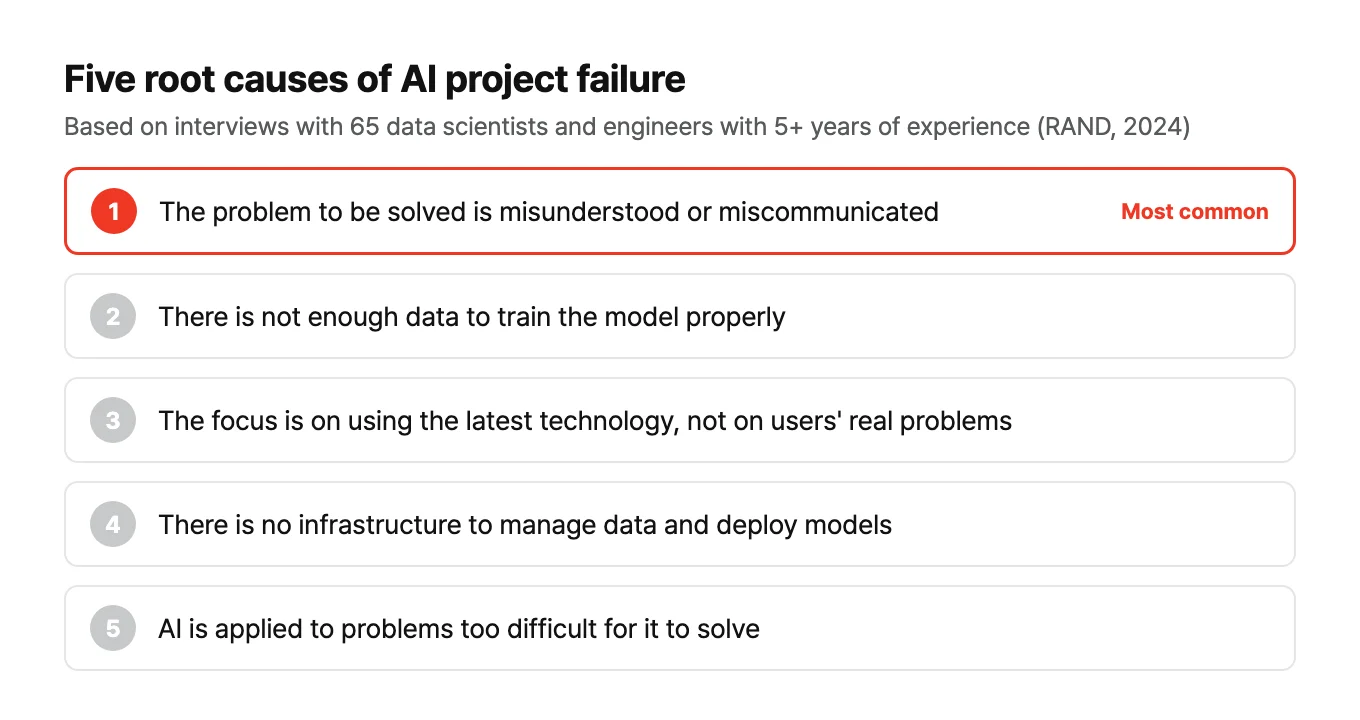
These five may sound like other companies' problems, but pick apart any service that was actually shut down and nearly every case is caught on at least one of them. The real question is whether you learn this before you build or after.
We have already laid out, in five stages, how you find out after building in Failing AI Projects. This piece covers the step before that: what to do while nothing has been built yet.
Principle 1. Turn each failure into a "cause statement"
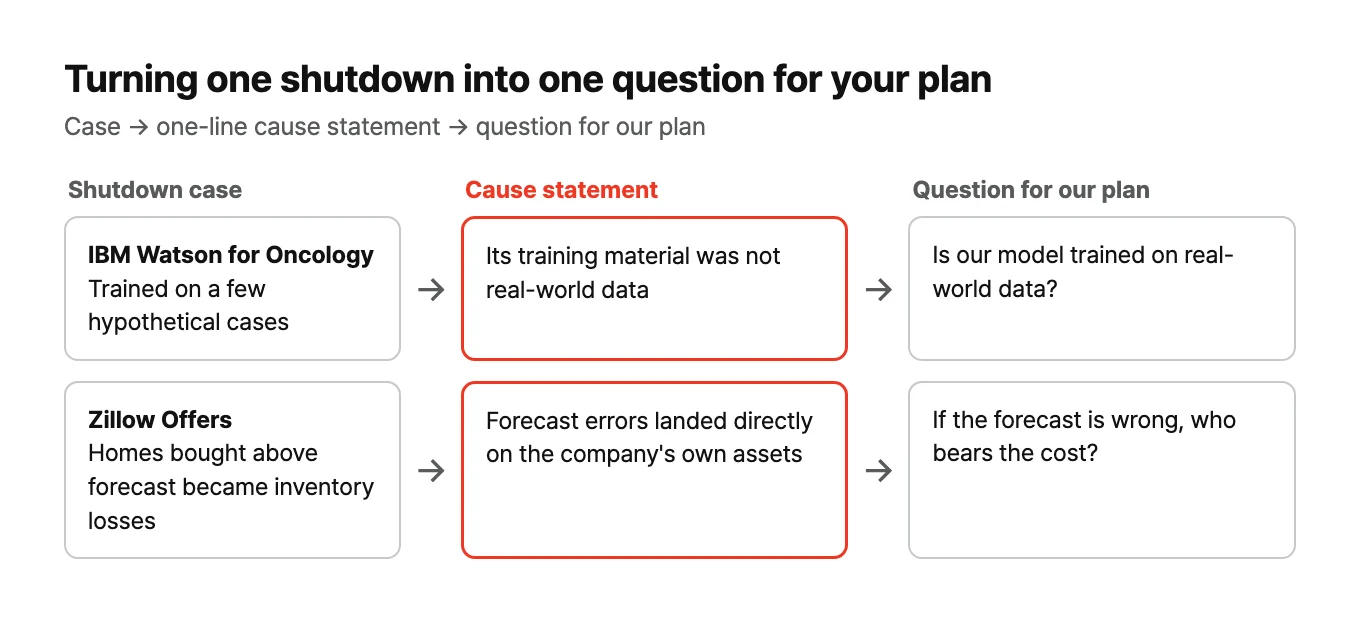
Simply collecting cases only gives you more to read. To use them in design, write one sentence for each case on "why it was shut down." Here are two examples.
IBM Watson for Oncology. In 2018, internal IBM documents obtained by the US health news outlet STAT showed that IBM's own specialists and customers had repeatedly found "unsafe and incorrect treatment recommendations" from this cancer treatment recommendation system. The documents pointed to how it was trained. Instead of real patient data, it was trained on a small number of hypothetical cases, and its recommendations relied on the judgment of a few specialists per cancer type rather than on guidelines or evidence. Reduced to a cause statement: "Its training material was not real-world data."
Zillow Offers. The US real estate platform Zillow ran a business that used algorithms to predict home prices and then bought and sold homes directly, until it shut the business down in November 2021. According to Zillow's third-quarter results announcement, it recorded an inventory write-down of roughly $304 million in that quarter alone for homes bought above expected sale prices, and it decided to cut about 25% of its workforce. The cause statement: "Forecast errors landed directly on the company's own assets." Every model is a little wrong at times. Zillow built a business in which that error turned straight into inventory losses.
Once you have cause statements like these, you can put questions straight to your own plan. Is our model trained on real-world data? If our predictions are wrong, who bears the cost?
Principle 2. Look for where it broke in the "moment of use," not in the technology
Many abandoned products did not fail because the technology didn't work at all. They failed because they never fit into the user's day.
The Humane AI Pin. Humane, a startup that set out to replace the smartphone with a wearable AI device, raised $230 million from investors. But according to Fortune, HP acquired the company for $116 million in February 2025, and devices already sold stopped working normally from February 28. A well-known tech reviewer called it one of the worst products he had ever reviewed, citing speed, reliability and battery life. It was a device that did what smartphones already did, only less conveniently.
AI digital textbooks. In Korea, AI digital textbooks were introduced for English, math and computing in some grades starting in the first semester of the 2025 school year. But according to the Kyunghyang Shinmun (in Korean), the adoption rate was only about 33% and the actual access rate was below 10%, while teachers' groups criticized the rushed rollout without a trial period. On August 4, 2025, the National Assembly passed an amendment to the Elementary and Secondary Education Act that reclassified AI digital textbooks as educational materials rather than textbooks. The cause statement: "Full rollout was decided before users had a real chance to try it."
Both cases fall under the third cause in the RAND report: putting technology ahead of the user's real problem. When you read a failure case, rather than asking "did the technology work," find and write down "who tried to use this, when, and at what moment." If that moment overlaps with how your product will be used, there is a good chance you will stumble in the same spot.
How to collect cause statements
Once you have ten to twenty cases, common weak points begin to emerge. The method is simple.
- Search for product names similar to your idea together with terms like "shut down," "discontinued," "service ended" or "withdrawal."
- Prioritize primary sources: shutdown notices posted by the company itself, earnings releases, regulator documents. Do not record reasons you could not source.
- For each case, write down when it started and when it ended, the reason the company gave and the reason outside analysts gave, side by side. On the last line, write a single cause statement.
Here are the four cases from this piece organized that way.
| Case | Timing | Stated reasons | Cause statement |
|---|---|---|---|
| IBM Watson for Oncology | Internal documents reported in 2018 | Trained on a small number of hypothetical cases, relied on a few specialists' judgment | Its training material was not real-world data |
| Zillow Offers | Wind-down announced November 2021 | Homes bought above expected sale prices, quarterly inventory write-down of about $304 million | Forecast errors landed directly on the company's own assets |
| Humane AI Pin | Acquired by HP in February 2025, devices stopped working | Harsh reviews of speed, reliability and battery | It made what smartphones already did less convenient |
| AI digital textbooks (Korea) | Reclassified as educational materials in August 2025 | Adoption about 33%, access under 10%, rollout without a trial period | Full rollout was decided before users had a real chance to try it |
With AI search tools, collection and organization take about half a day. But deciding which reason is the real cause is a judgment people have to make. Other questions to review before starting are collected in our AI readiness checklist.
In short
Most AI product ideas are not new. What can be new is a design that knows where earlier companies fell and steps around those spots. The first steps are collecting abandoned cases, reducing each to a one-sentence cause, and looking for where things broke in the moment of use rather than in the technology.
In the next part, we cover how to carry these cause statements into an actual design table and a premortem meeting.
Series: "Building an AI Product? Read the Failures First"
- Extracting cause statements from companies that shut down (this article)
- Designing with fix lists and a premortem
References
- RAND Corporation, The Root Causes of Failure for Artificial Intelligence Projects and How They Can Succeed (2024)
- STAT, IBM's Watson supercomputer recommended 'unsafe and incorrect' cancer treatments, internal documents show (2018)
- Zillow Group, Third Quarter 2021 Financial Results; Plan to Wind Down Zillow Offers Operations (2021)
- Fortune, report on HP's acquisition of Humane and the shutdown of the AI Pin (2025)
- 경향신문, AI 디지털교과서 교육자료 격하 법안 국회 통과 (Kyunghyang Shinmun, bill downgrading AI digital textbooks to educational materials passes the National Assembly) (2025)