Building an AI Product? Read the Failures First: Designing with Fix Lists and a Premortem (2)
Cause statements drawn from failure cases only become useful once they move into a design table and a meeting. This piece covers how to turn the change list of Lee Luda 2.0, a Korean chatbot that was shut down and then relaunched after fixes, into a checklist; how to run the premortem Gary Klein introduced in Harvard Business Review; and a six-step sequence for finishing a failure analysis in half a day.
Once you have extracted causes from other companies' failures, it is time to carry them into your own design. The most valuable material is the change list of a company that fell, fixed what was broken and got back up.
What comes after the cause statement
In the previous part, we collected discontinued AI services and reduced each to a single sentence on why it was shut down. Sentences like: its training material was not real-world data; forecast errors landed on the company's own assets; full rollout was decided before users had tried it.
If you just read these sentences and move on, they stay lessons. They change your product only when they become a row in a design table and a question in a meeting. This part covers how to make that transfer.
Principle 3. Take the "fix list" from cases that got back up
Among failure cases, the most valuable are the ones that were shut down, fixed and relaunched. What they fixed becomes a ready-made checklist.
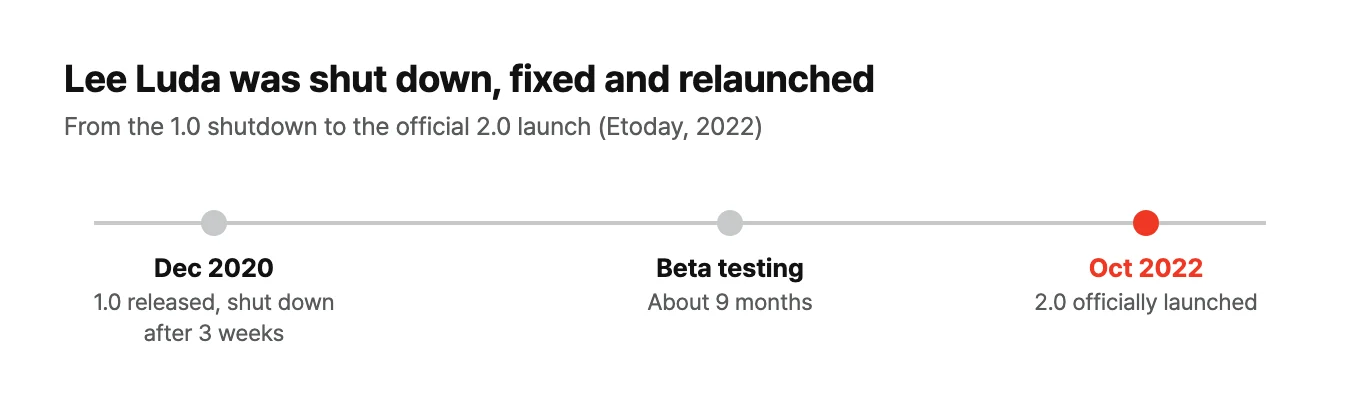
The Korean AI chatbot Lee Luda is a prime example. Lee Luda 1.0, released in December 2020, was suspended after three weeks amid controversy over users' sexual harassment of the chatbot and the chatbot's own hate speech. The developer ran about nine months of beta testing and officially launched Lee Luda 2.0 in October 2022. According to Etoday (in Korean), these were the changes:
- Pseudonymized the training data by deleting or randomly replacing names, email addresses and similar details
- Had a generative model compose new sentences instead of retrieving existing ones
- Added an abuse detection model and set a target of 99% safe responses, reaching 99.56%
- Introduced penalties for users who attempt abnormal conversations
Any company planning a conversational AI service could use this list as a pre-launch checklist as is. It is like getting, for free, a list someone else paid dearly for. If your field has no case of a service that got back up, look for improvement notices a company published after a similar incident, or corrective orders from regulators. Any document that lists what was fixed serves the same purpose.
Principle 4. Write your own failure in advance
Once you have read other companies' failures, the last step is to write your own in advance. The premortem, which cognitive psychologist Gary Klein introduced in Harvard Business Review in 2007, is the right tool for this.
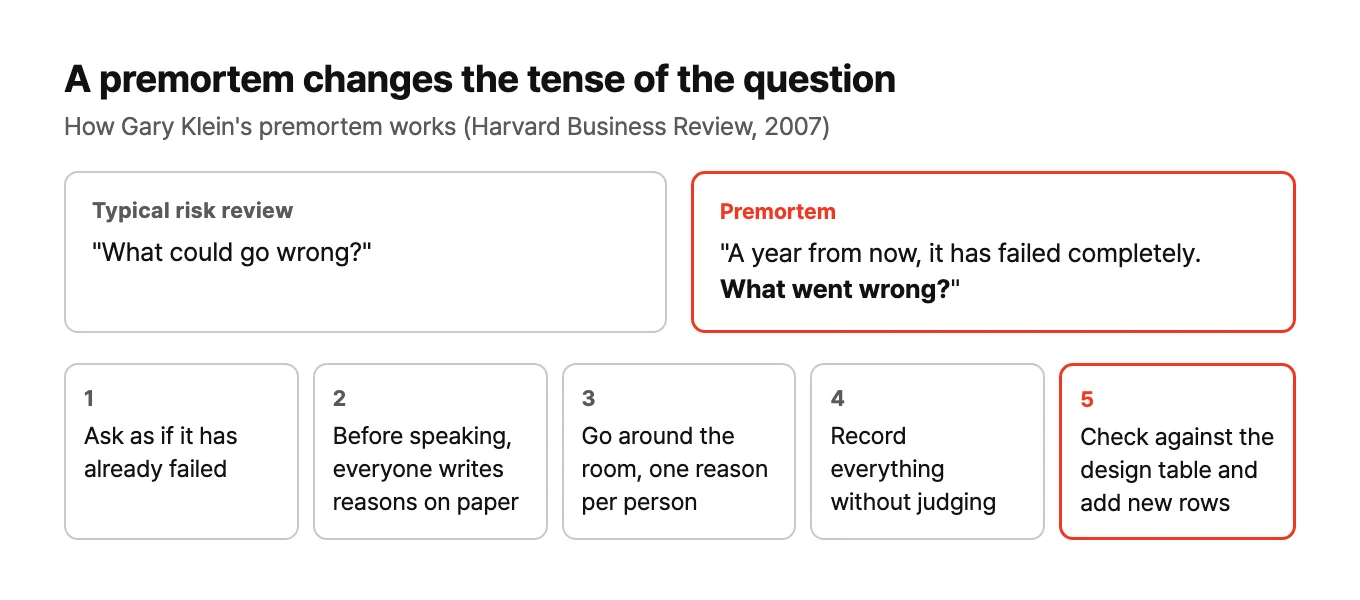
The method is simple. At the project kickoff meeting, ask, "Imagine it's a year from now and this project has failed completely. Why did it fail?" Give each participant a few minutes to write down reasons, then have them present one by one. The key is asking "what went wrong" rather than "what could go wrong." When you treat the failure as something that has already happened, concerns people usually keep to themselves for fear of spoiling the mood come out far more easily.
Put the list of cause statements from the previous part beside you, and the answers become specific. Instead of vague answers like "customers didn't use it," you get sentences like "the training data wasn't photos from our own sites" or "we absorbed the losses when the predictions were wrong." This is also why leadership should sit in on this meeting. Some of those sentences describe problems of business structure, not technology, and only leadership can fix those.
A few rules are enough to run it well. Have everyone write their reasons on paper before anyone speaks. If the most senior person's view comes out first, the rest of the answers drift toward it. Go around one reason per person, and write down every reason without judging it. After the meeting, compare the list with the left column of the design table and add any new reasons as new rows.
The sequence: half a day is enough
A failure analysis doesn't need a big budget. With AI search tools, collecting and organizing cases takes about half a day. The judgment, though, has to come from people.
- Collect 10 to 20 cases. Search for product names similar to your idea together with terms like "shut down," "discontinued," "service ended" or "withdrawal." The AI Incident Database, which collects AI-related incidents and failures, is also a good starting point.
- Fill in four fields for each case. When it started, when it ended, the reason the company gave, the reason outside analysts gave. Prioritize primary sources, and do not record reasons you could not source.
- Group the causes into four or five statements. Clustering similar reasons usually brings them down to four or five.
- Build a design table. In the left column, write "where it broke"; in the right column, "how we avoid it." Rows where you cannot fill in the right column should not be deleted. Move them to remaining risks.
- Hold a premortem. With the design table beside you, ask, "If this failed a year from now, why?"
- Put the remaining risks in the report to leadership. Starting with known, unavoidable risks is different from starting without knowing them.
The design table in step 4 looks like this. Move the cause statements from the previous part into the left column and fill in the right column for your situation. The right column below is an example of how to fill it in.
| Where it broke (cause statement) | How we avoid it (example) |
|---|---|
| Its training material was not real-world data | Train and test on data collected from our own operations |
| Forecast errors landed directly on the company's own assets | Set a loss limit for wrong predictions before anything else |
| Full rollout was decided before users had a real chance to try it | Try it with one team first, then expand |
| A row whose right column cannot be filled | Don't delete it; move it to remaining risks and include it in the report to leadership |
This table also helps when working with outside vendors. Don't just listen to the success stories a vendor presents. Show them the left column of your design table and ask, "How do you avoid this?" We cover how to filter vendor pitches in more detail in Decoding AI Vendor Marketing. For how to verify results after building, see How Do You Verify What AI Produces?
In short
Once you have collected failure cases and reduced each cause to a sentence, take the fix list from cases that recovered, move it into a design table, and write your own failure in advance.
If the idea still seems worth doing after all that, it's not too late to start building then. And if this process makes you drop the idea, you have spent half a day to save months and a budget.
We documented our own experiment on this topic in Reading Skin from a Photo, Keeping Only Ingredients with Evidence.
Series: "Building an AI Product? Read the Failures First"
- Extracting cause statements from companies that shut down
- Designing with fix lists and a premortem (this article)