Splitting Content Production Across AI — How to Break Up the Process and Place Review Checkpoints (1)
With AI handling the script, the voice, the footage and the captions, one person can now produce a whole video. What remains is review. Drawing on how a broadcaster runs its AI anchor, the spread of low-quality AI video and YouTube's monetization policy, CNET's AI article errors, and the AP's generative AI standards, this article lays out how to divide content production into stages and where to put human checks between them.
Anyone can make a video now. The difference lies in what you filter out.
One person can now make a whole video
Say a marketing manager wants to turn a company blog post into an explainer video for YouTube. Not long ago, a person had to do everything: write the script, record the narration, find footage, cut it and add captions. Outsourcing cost money; doing it yourself took days.
Today AI splits most of that work. A language model reads the post and writes the script, text-to-speech (TTS) reads it aloud, an image model picks the visuals and a transcription model makes the captions. Even among Korean tools, VoyagerX's Vrew (in Korean) offers a "text to video" feature that generates the script, images and voice in one go.
Broadcasters started early. Korean broadcaster MBN introduced its "Kim Ju-ha AI anchor" in 2020 (in Korean). It trained the system on 10 hours of video and audio of the real anchor and said it could turn up to 1,000 characters of text into video within a minute. The part worth noticing comes next: reporters write the script, and the producer in charge edits the captions and video before anything is uploaded. The AI stands in front of the camera, but responsibility for the script and the edit stays with people.
That structure is what a small or mid-sized company should borrow when it automates content. Before deciding what to hand to AI, decide where a person checks the work.
Easier to make, so more common
When something gets easy to make, a predictable thing happens. According to the AI Slop Report published in November 2025 by video editing service Kapwing, 104 of the first 500 videos (21%) shown in a fresh account's YouTube Shorts feed were low-quality AI-generated videos. In the same report, South Korea was the country where such channels drew the most views.
Platforms have started drawing lines. In July 2025 YouTube renamed the "repetitious content" item in its monetization policy to "inauthentic content" (in Korean), making clear that videos mass-produced from nearly the same template are not eligible to earn money. Using AI is not banned in itself. What YouTube targets is volume production with no human commentary or structure.
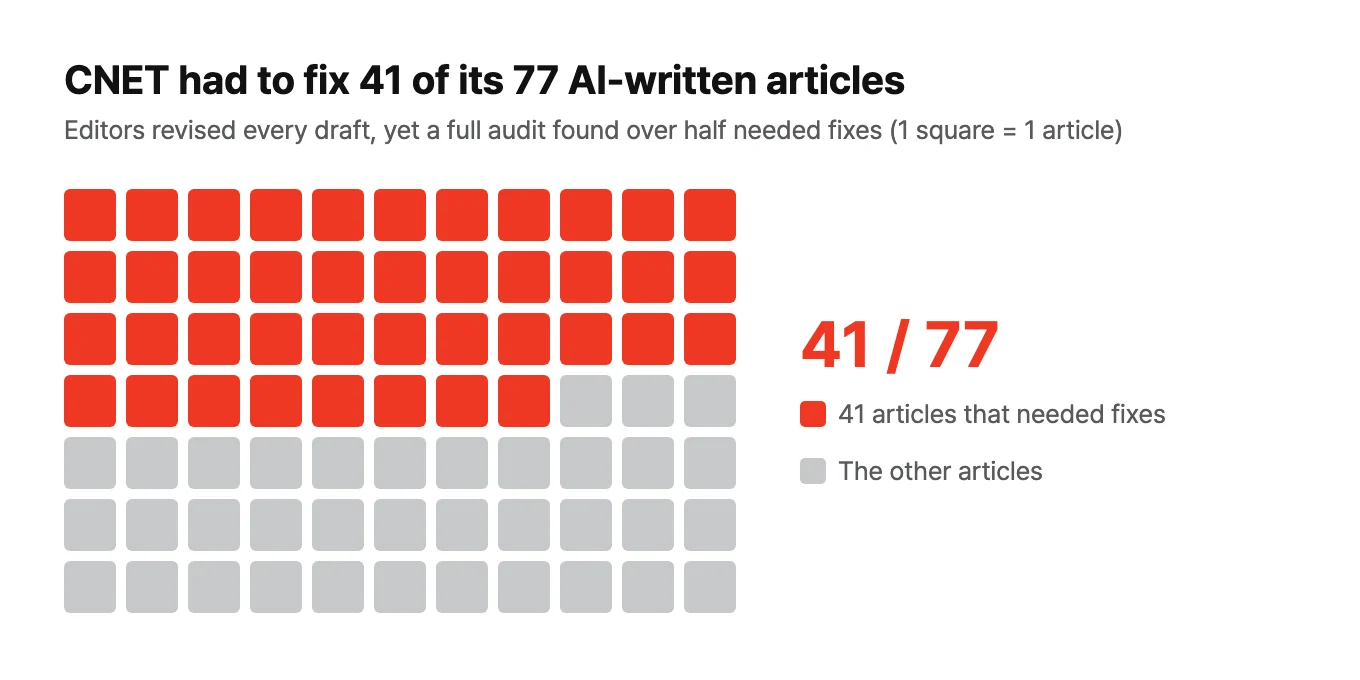
Quality incidents have already happened. The US tech outlet CNET began publishing 77 basic personal finance explainers written with an AI tool in late 2022. After outsiders pointed out errors, a full review found that 41 of them needed corrections. Many had partial company names or numbers that were swapped, and some sentences were rewritten because they were too close to the original sources. This happened even though editors revised the drafts before publication.
For a company channel, mistakes like these cost more than for a personal one. A single wrong number, or a single photo with unclear rights, chips away at brand trust. That is why you should decide first how to split the process and where to put the reviews.
Principle one: break up the process and keep an output from every stage
If you hand off "turn this post into a video" in one request, you cannot tell what went wrong or where. Split the process and keep an intermediate output from each stage that a person can open and inspect.
| Stage | AI that handles it | Intermediate output to keep |
|---|---|---|
| Script | Language model | A line-by-line text file, with the source sentence each line is based on placed next to it |
| Voice | Text-to-speech (TTS) | Line-by-line audio plus a transcript, so you can check how numbers and foreign words were read |
| Visuals | Image model | A list of files per shot, with the original URL and license terms |
| Captions & assembly | Transcription model | The final video and a shot list (which material appears at which second) |
With the work split this way, you can rerun just the stage that went wrong. If the voice misread a number, you leave the script and visuals alone and fix only the audio.
The generative AI standards that the Associated Press released in August 2023 say that all output from generative AI tools should be treated as "unvetted source material." Just as a reporter does not print a source's words without checking them, an AI-written script is only raw material until it has been checked. Keeping intermediate outputs is the habit that makes this principle workable in practice.
Principle two: review between stages, not once at the end
Watching the finished video from start to finish and saying "looks fine" catches almost nothing. Video flows past, and the eye accepts a plausible image as a correct one. CNET's articles, remember, were read by editors before they went out.
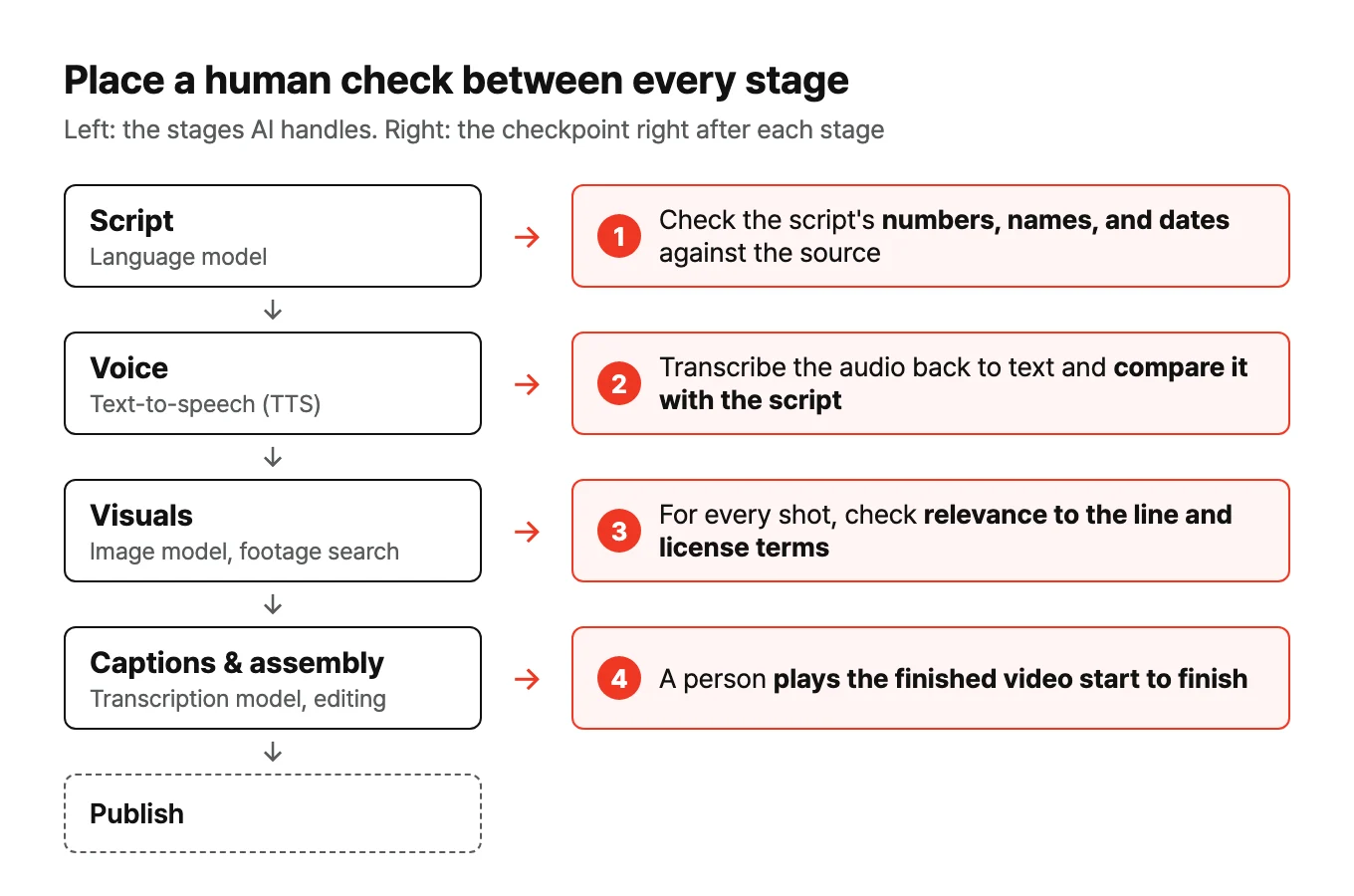
Put checkpoints where an error would derail every stage after it. In practice, four points pay off the most.
- Compare the script's numbers against the source: check that every figure, proper noun and date in the script appears in the source as written. If a number shows up that is not in the source, stop, no exceptions. A script does this comparison more accurately than a person.
- Compare a transcript of the audio against the script: run the TTS output back through a transcription model and compare the text with the script. This is where you catch whether a figure such as 600 million was read correctly, or an English product name was mangled.
- Check each visual's relevance and rights: for every shot, confirm it relates to the line being spoken, that no watermarks or ads slipped in, and that the license terms have been checked. If a map appears on screen, place names need checking too.
- Play the finished video: finally, a person watches it once from start to finish. This cannot replace the three checks above.
We cover how to verify AI output in How Do You Verify What AI Built and the problem of AI being confidently wrong in When AI Is Confidently Wrong. In a content workflow, the key is to break that verification into small pieces and slot them between stages.
What to do in the first month
Do not try to automate every stage from day one.
- Draw one process chart: split it into script, voice, footage, captions, assembly and publishing, and write down for each box who handles it, AI or a person.
- Set the four checkpoints: number comparison, transcript comparison, visual check and full playback. Put a name next to each.
- Test three videos, then scale: for the first three, have a person open every stage's output. Move the items that fail most often into automated checks, and only then increase volume.
In short
You can split the script, the voice and the footage search across AI. What you cannot hand off is the judgment of whether it made up anything that is not in the source. Do not save that judgment for one pass at the end; spread it between the stages.
The next article covers the right to use visual material, voices and copyright, and the AI labeling that Korea's AI Framework Act and YouTube require.
Series: Splitting Content Production Across AI
- How to Break Up the Process and Place Review Checkpoints (this article)
- Weighing Sources, Rights and AI Disclosure Separately
References
- 보이저엑스, 브루 텍스트로 비디오 만들기 (VoyagerX, Vrew text to video; in Korean)
- 뉴데일리, MBN 김주하 AI 앵커 도입 (2020) (NewDaily, MBN introduces Kim Ju-ha AI anchor; in Korean)
- Kapwing, AI Slop Report: The Global Rise of Low-Quality AI Videos (2025)
- 한국경제, 유튜브 비진정성 콘텐츠 수익화 정책 (2025) (Korea Economic Daily, YouTube's inauthentic content monetization policy; in Korean)
- Talking Biz News, CNET found errors in more than half of its AI stories (2023)
- Associated Press, Standards around generative AI (2023)