Splitting Content Production Across AI — Weighing Sources, Rights and AI Disclosure Separately (2)
When AI finds your material, citing sources gets easier, but citing a source does not make the material yours to use. This article separates the questions: how to read KOGL and Creative Commons terms, AI voices and Korea's Unfair Competition Prevention Act, the US voice actors' lawsuit against Lovo, copyright registration standards for AI output, and the AI Framework Act's transparency guidelines alongside YouTube's rules on disclosing synthetic content.
Citing a source and checking whether you may use it are two different jobs. With AI labeling, too, what the law requires and what platforms require are different things.
The previous article covered how to split content production into stages and place review checkpoints between them. This one covers the two calls that are hardest to make at those checkpoints: the right to use material, and AI disclosure.
Citing a source and having the right to use it are different questions
When AI handles the footage search, citing sources actually gets easier, because the machine records every place it pulled something from. The problem is that writing down a source does not make the material something you are allowed to use.
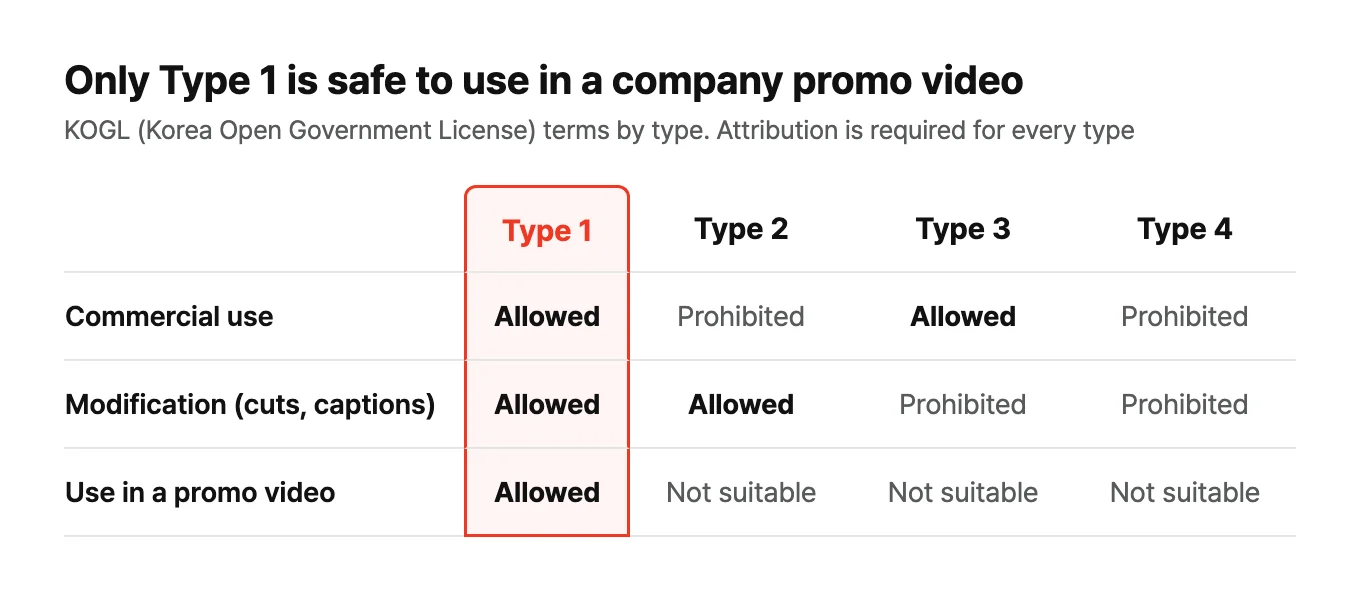
Start with material whose license terms are stated. For Korean public works, look for the KOGL (in Korean) mark, the Korea Open Government License that public bodies attach to their works. Type 1 allows both commercial use and modification as long as you credit the source; Type 2 prohibits commercial use, Type 3 prohibits modification, and Type 4 prohibits both. A company promo video is commercial use, and cutting footage and adding captions is modification, so in practice only Type 1 is safe. Creative Commons licenses, common for material from other countries, need the same check: look for NC (non-commercial) and ND (no derivatives) conditions.
Treat voices and faces separately from copyright. In Korea, the amended Unfair Competition Prevention and Trade Secret Protection Act (in Korean), in force since 2022, classifies the unauthorized commercial use of another person's name, likeness, voice, signature and the like, where these are widely known in Korea and carry economic value, as an act of unfair competition. A video that introduces a product in an AI voice resembling a celebrity can be a problem regardless of copyright.
In the United States, two voice actors sued the AI voice company Lovo. The plaintiffs claimed they made recordings after being told they were for research, and that their voices were then cloned and sold as commercial voices. In July 2025 a federal court in New York declined to dismiss several of their claims, including breach of contract and violation of New York's privacy law, and let the case proceed. When choosing a TTS service, check its terms to see what consent the voices were built on and whether commercial use is permitted.
Think about the rights to the videos you make, too. The guide to copyright registration for generative AI (in Korean) issued in June 2025 by Korea's Ministry of Culture, Sports and Tourism and the Korea Copyright Commission treats the parts that reflect human creative contribution, not the AI output itself, as eligible for registration. The US Copyright Office concluded in a January 2025 report that output produced from prompts alone is unlikely to be protected. If you want company content to build into an asset, keep records of human involvement: planning documents, script revision history and editing decisions.
Look at AI labeling through the law and the platform separately
Two claims circulate at the same time: "Anything made with AI must be labeled" and "We're not covered." Both are only half right.
Korea's AI Framework Act. The AI Framework Act, in force since January 22, 2026, requires that generative AI output be labeled as AI-made, and that output hard to tell apart from reality be disclosed so that users can clearly recognize it. The transparency guidelines that the Ministry of Science and ICT released the day before the Act took effect (in Korean) assign this duty to AI business operators that provide AI products or services directly to users, and explain that users who employ AI as a tool for work or creative production are not subject to it. Fact-finding investigations that could lead to fines are suspended for a grace period of at least one year (in Korean).
A company that makes promo videos with AI tools and posts them is usually a user. But if it puts an AI customer service chatbot on its website, or offers a feature that lets customers generate images with AI, it becomes an operator. We covered the law as a whole in The AI Framework Act Is Now in Force.
YouTube. Even without a legal duty, the rules of the platform you post on still apply. Since March 2024, YouTube has required creators to disclose, on the upload screen, synthetic or altered content that viewers could mistake for a real person, place or event. Its examples of content that needs disclosure include synthetically generating a real person's voice to narrate a video. Conversely, YouTube says that using AI to generate scripts or ideas, or to add captions automatically, does not need to be disclosed.
| Korea's AI Framework Act (in force January 22, 2026) | YouTube (since March 2024) | |
|---|---|---|
| Who must comply | AI business operators that provide AI products or services directly to users | The person uploading the content |
| What must be disclosed | That output is generative AI output; output hard to tell apart from reality | Synthetic or altered content that could be mistaken for a real person, place or event |
| Not covered | Users who employ AI as a tool for work or creative production | Using AI to generate scripts or ideas, or to add captions automatically |
| Also note | Fact-finding investigations that could lead to fines are suspended for a grace period of at least one year | Narrating with a synthesized real person's voice requires disclosure |
For a working rule, use this: if anything synthetic looks or sounds real, disclose it. If in doubt, disclose. You lose almost nothing by disclosing, and a great deal if you hide it and it comes out.
Three things to set up in practice
- Make a do-not-use list first: write down the sources you will not use (image collection sites with unknown creators, clips lifted from ordinary YouTube videos without permission, and so on) and the voices you will not use (imitations of real people). This comes before automation.
- Keep a rights register: a table recording the original URL, license type and date checked for every shot. The source list in the video description comes from here too.
- Set your AI labeling rule: when a synthetic voice or synthetic person appears, turn on the platform's disclosure setting and note it in the description as well.
If employees already use AI tools on their own, adding one line for each of these rules to your AI usage policy saves you from writing a separate document.
In short
The cost of making a video has fallen sharply. So a company channel's edge is decided not by how many videos it puts out but by whether it built them from material it may use, and whether it disclosed what it should.
This article is intended to aid general understanding. For specific legal obligations and rights, we recommend checking the actual laws and guidelines and, where necessary, seeking professional review.
The hands-on experiment behind this topic is written up in I Fed It One Article and Got a Narrated Video Back.
Series: Splitting Content Production Across AI
- How to Break Up the Process and Place Review Checkpoints
- Weighing Sources, Rights and AI Disclosure Separately (this article)
References
- 한국저작권위원회, 공공누리 유형 안내 (Korea Copyright Commission, KOGL license types; in Korean)
- Creative Commons, About CC Licenses
- 국가법령정보센터, 부정경쟁방지 및 영업비밀보호에 관한 법률 (Korean Law Information Center, Unfair Competition Prevention and Trade Secret Protection Act; in Korean)
- Pollock Cohen, Key Rulings in Voice Cloning Case Against Lovo (2025)
- Loeb & Loeb, Lehrman v. Lovo, Inc. (2025)
- 문화체육관광부, 생성형 인공지능 관련 저작권 등록·분쟁 예방 안내서 2종 (2025) (Ministry of Culture, Sports and Tourism, two guides on copyright registration and dispute prevention for generative AI; in Korean)
- U.S. Copyright Office, Copyright and AI Part 2: Copyrightability (2025)
- 과학기술정보통신부, 인공지능 투명성 확보 가이드라인 공개 (2026) (Ministry of Science and ICT, AI transparency guidelines released; in Korean)
- MSIT, Guidelines on Ensuring AI Transparency (2026)
- 정책브리핑, 인공지능기본법 22일 시행 (2026) (Korea Policy Briefing, AI Framework Act takes effect on the 22nd; in Korean)
- YouTube, How we're helping creators disclose altered or synthetic content (2024)